Most Mains preparation is a stack of unrelated activities — read a book, watch a lecture, write an answer, forget it. Swādhyāya's Mains module runs the same four steps every aspirant needs, in order, on every question.
Why activity-based Mains prep leaks
A typical week: two lectures, three notes-refreshes, four answer attempts submitted to a test series. The activities look right. The improvement doesn't come. Because these activities don't compound — they replace each other. What was written last week isn't being retested this week; what was corrected in a review isn't being applied to the next attempt.
The four steps that have to compound
Every Mains-relevant question has to go through the same loop:
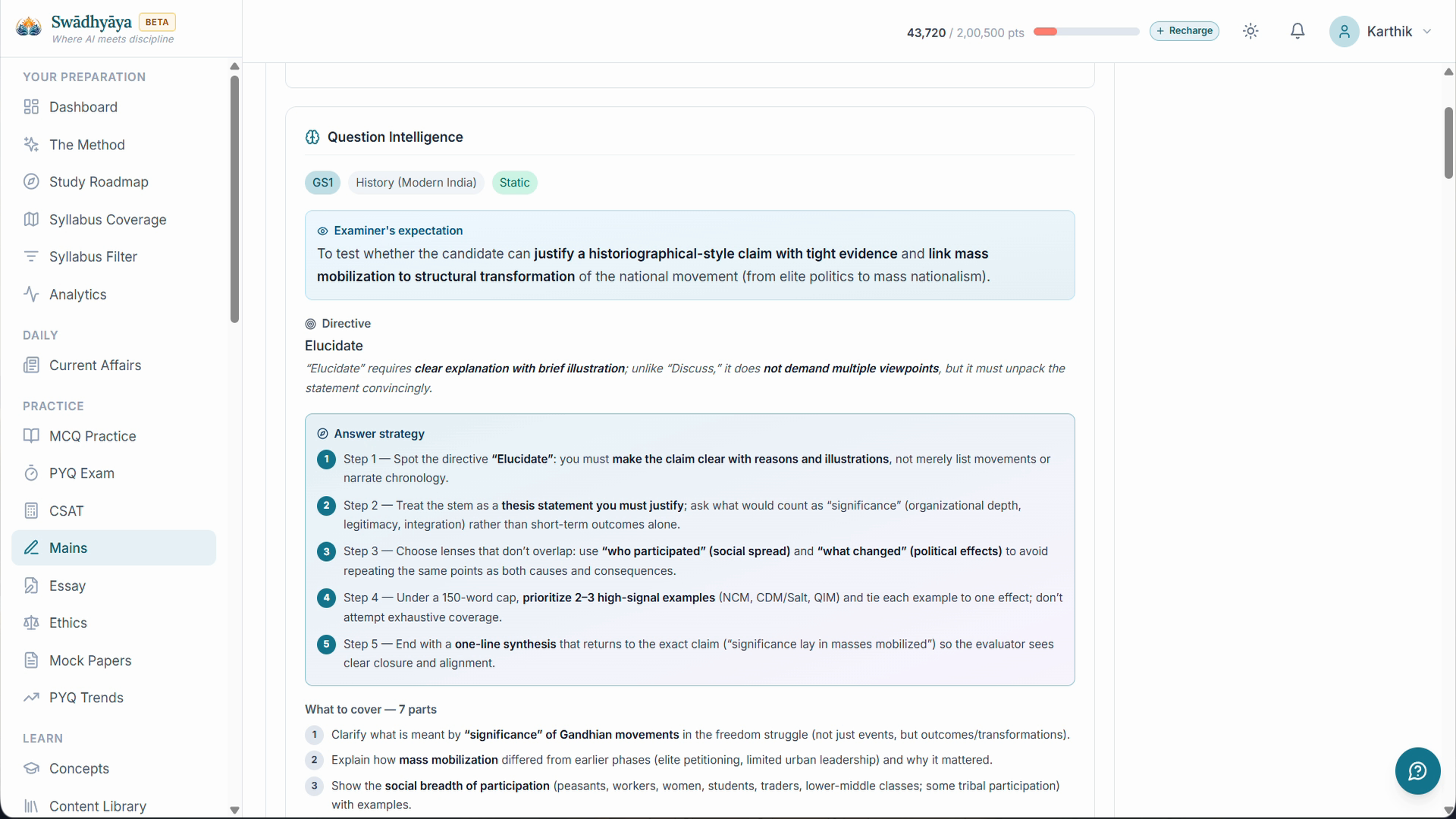
- Decode — directive, examiner intent, sub-demands, word strategy. Two minutes before writing.
- Write — with a directive-aligned frame (intro commits, body defends, conclusion returns).
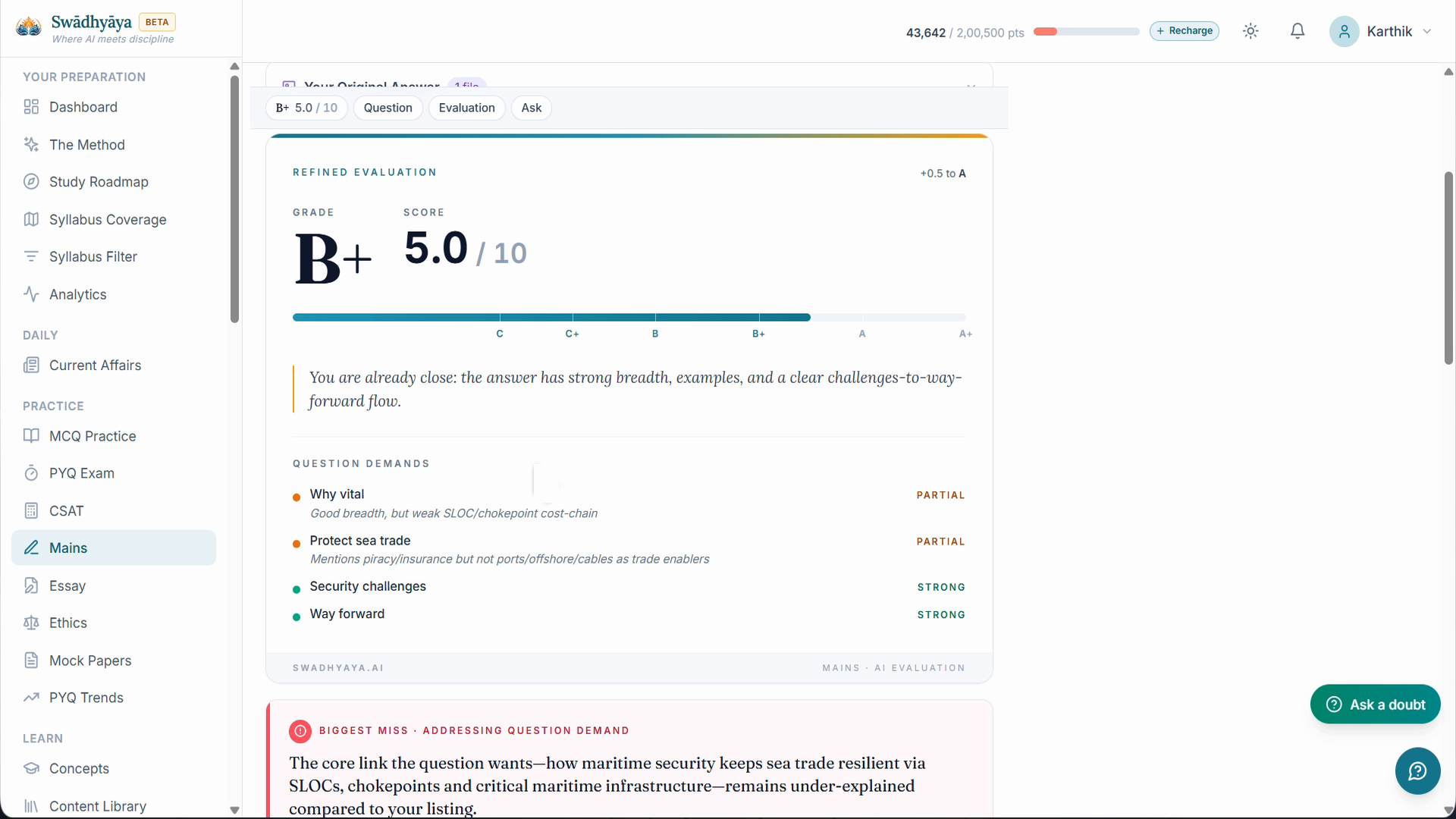
- Evaluate — dimension by dimension. Not "6.5/10." Structure, content, argument, directive alignment — each with a specific fix.
- Track — the fix carries forward. Next attempt on a similar directive, you can see what you did last time.
Any step missing and the loop leaks. Test series stop at Step 2. Notes-based prep never even reaches Step 1.
How the Mains module runs the loop
Every Mains question — PYQ or Swādhyāya-generated — opens with a Question Intelligence card: directive breakdown, examiner intent, sub-demands, word budget per section. You read this before you write. Two minutes.
You write directly on the platform (typed or handwritten PDF). AI evaluation returns dimension-wise feedback + an enhanced model answer that keeps your voice but shows what your version would have been if you'd caught the gaps.
Every attempt gets a persistent prep card. Same directive pattern shows up two months later — Critically evaluate in a GS3 question — you can pull your last three attempts, see what worked, decide what to fix now.
What separates it from generic Mains tools
- Question Intelligence. Decode before you write. Nobody else does this.
- Dimension-wise evaluation. Not one grade — four axes with a specific fix each.
- Per-question prep cards. Persistent. Every attempt on every question carries forward.
- Diagram bank. Hand-drawable shapes (triangle, Venn, cycle, 2×2) per topic — reproducible under 90 seconds in the exam.
Where to start
Pick one PYQ you struggled with. Open its Question Intelligence card. Write. Submit for evaluation. Read the enhanced answer.
Do it once. If the loop feels different, do it again.