GS4 is the paper that rewards administrative judgment, not memorised definitions. The candidate who can name Aristotle's four virtues but can't reason through a stakeholder conflict scores in the middle band. Swādhyāya's Ethics module trains the reasoning.
Why definition-based Ethics prep falls short
The typical GS4 preparation: memorise every value with its definition, learn quotes from Kautilya to Kant, practise case studies by pattern-matching to whichever value seems relevant. This produces answers that name the right value but never actually navigate the dilemma the case posed.
Real cases don't have one clean value applying. They have three or four values in conflict, three or four stakeholders with different stakes, and a decision that has to weigh trade-offs the case doesn't spell out. Ethics answers score when they show the candidate can navigate that — not when they list values.
What Ethics preparation actually needs
- Dilemma clarification — what is the actual conflict? Naming the values in tension is Step 1 and most candidates skip it.
- Stakeholder mapping — who is affected? What does each stand to lose or gain? Whose perspective changes the calculus?
- Value hierarchy for context — administrative context often demands one value overrides another. Being able to argue which and why.
- Ethical frameworks as reasoning tools — deontological, consequentialist, virtue-ethics, care-ethics — used to reason, not to name-drop.
How Swādhyāya's Ethics module runs this
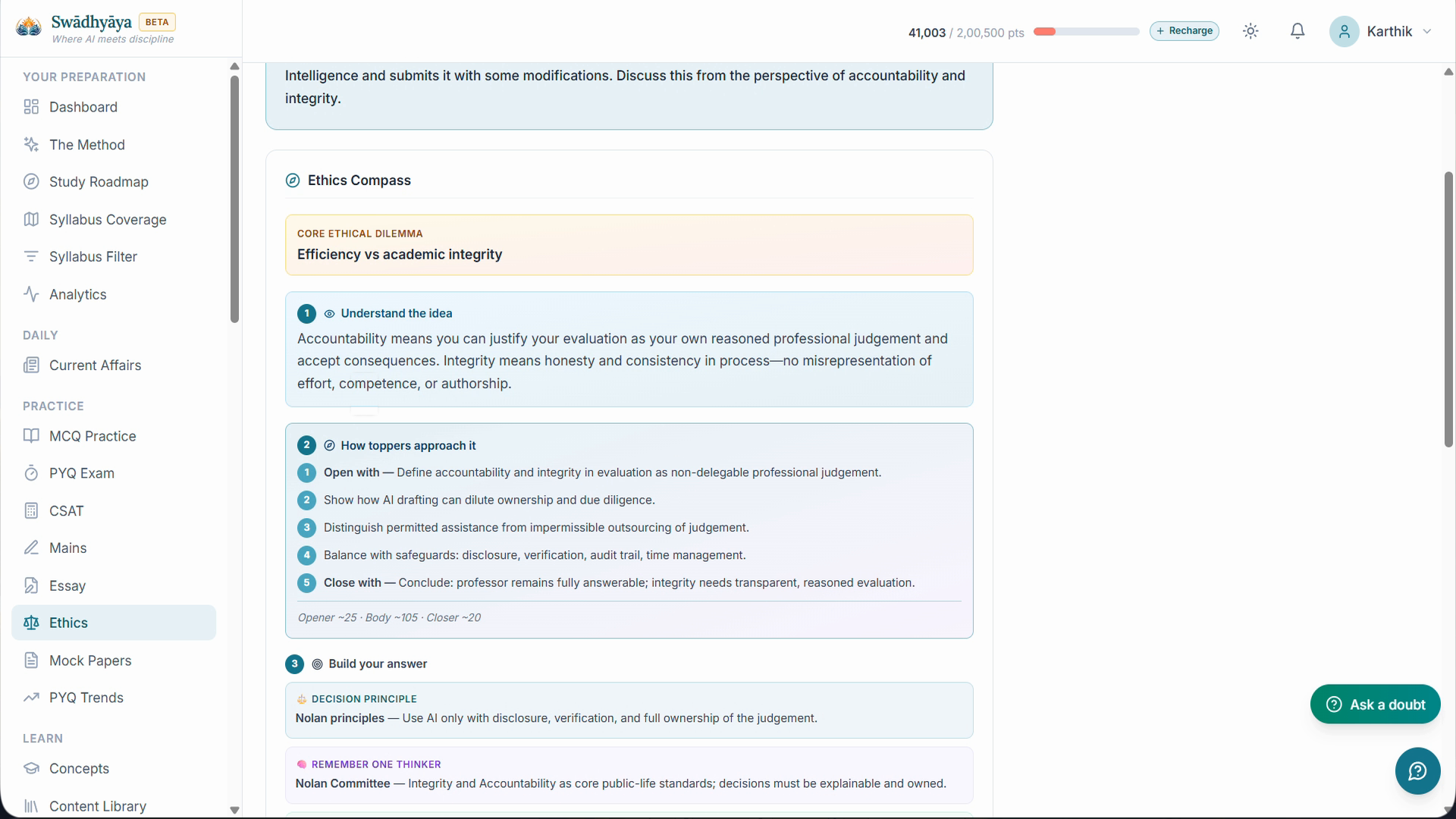
Every case study opens with a dilemma clarification — Swādhyāya's AI maps the values in tension, the stakeholders, and their competing stakes. You read this before writing so you're navigating a clear map, not a fog.
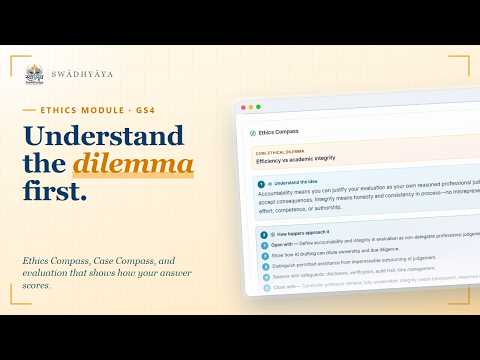
For Section A theory questions, the Ethics Compass reads the exact prompt and returns a five-step roadmap: what the question is actually testing, the conceptual anchor, the three arguments to develop, the counter-argument to acknowledge, and the 30-second revision. Distinct from Question Intelligence — GS4 Section A has its own logic.
You write your answer. AI evaluation returns dimension-wise feedback: dilemma clarity, stakeholder handling, framework usage, administrative-context judgment. Each with a specific fix.
What makes it different
- Ethics Compass for Section A. Purpose-built for GS4 theory — different from Question Intelligence's Mains-answer logic.
- Case-study dilemma navigation. Values in tension named before you write. Stakeholder map. Value hierarchy for the administrative context.
- Framework as tool, not label. Deontological / consequentialist / virtue reasoning used to actually solve the case, not to be quoted.
- Evaluation that reads administrative judgment. Not "you cited Gandhi." "Your decision under this pressure would have been X — here's the administrative reasoning."
Where to start
Pick a PYQ case study you found hard. Open its dilemma clarification. Sit with the stakeholder map for five minutes. Write. Submit for evaluation.
The answer will look different from the ones you've been writing.