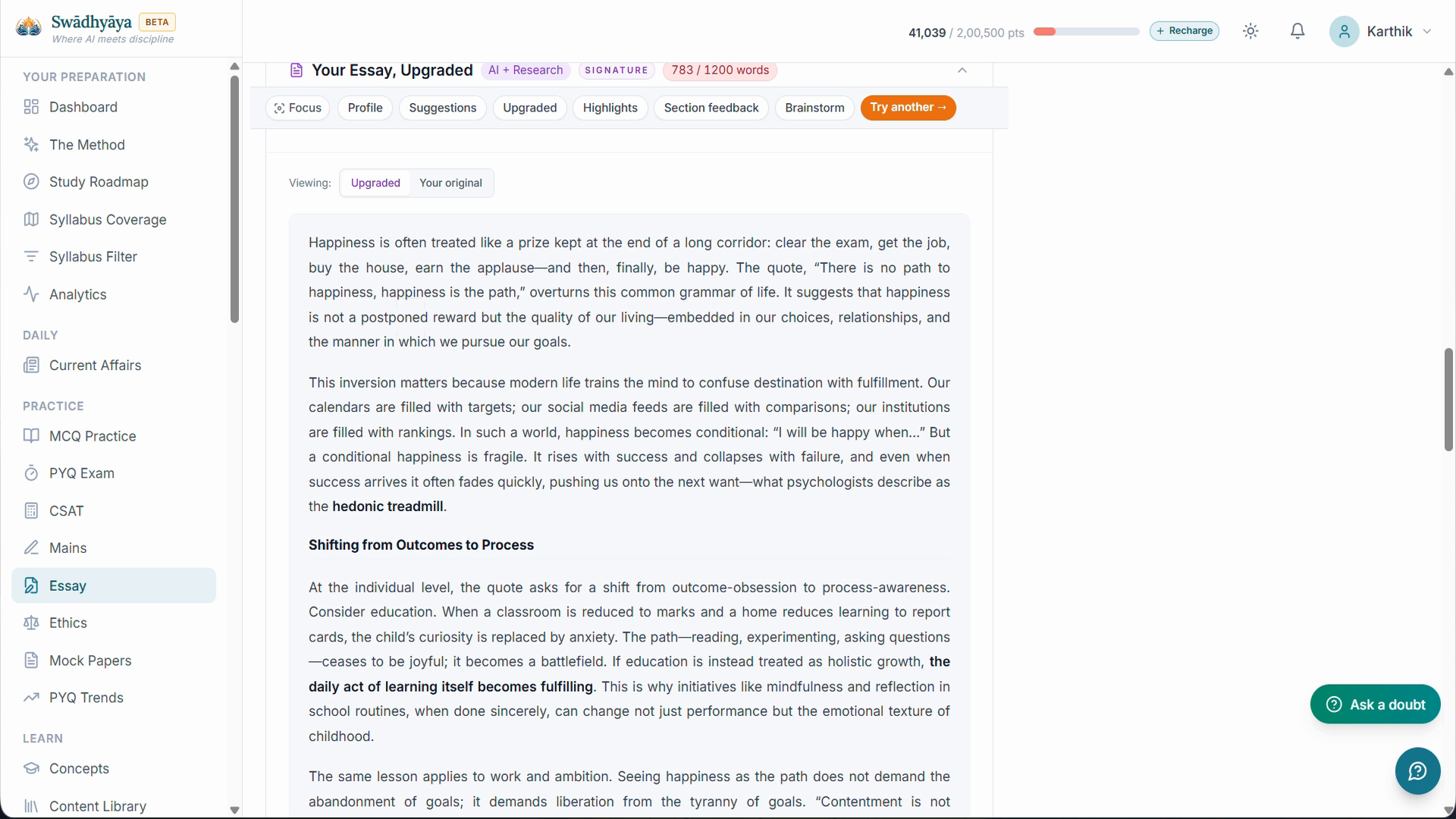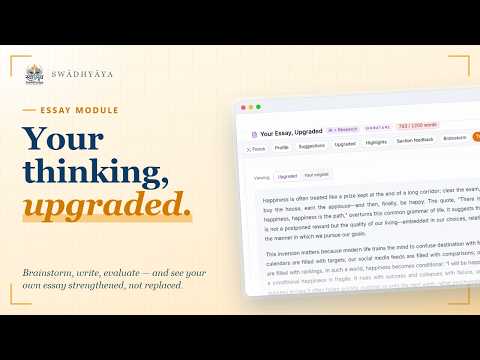
Essay is the paper where template thinking gets caught the fastest. What examiners reward is a mind that can hold a topic, move around it, and land somewhere earned. Swādhyāya's Essay module gives you the scaffold to do that reliably.
Why formula essays don't score
The typical Essay prep: memorise 50 quotes, three case studies per theme, a structure ("intro, six body paragraphs, conclusion"), and hope the topic on paper day fits one of them. This produces essays that read alike — Gandhian quote, Kalam anecdote, "in conclusion, technology is a two-edged sword." Examiners have seen a thousand of these. They score in the middle band.
The essays that score at the top don't sound like anyone else. They sound like someone actually thinking, on that specific topic, in real time.
What Essay preparation actually needs
- A brainstorm scaffold that opens the topic on multiple dimensions — historical, philosophical, ethical, contemporary, personal — without collapsing into one prefab structure.
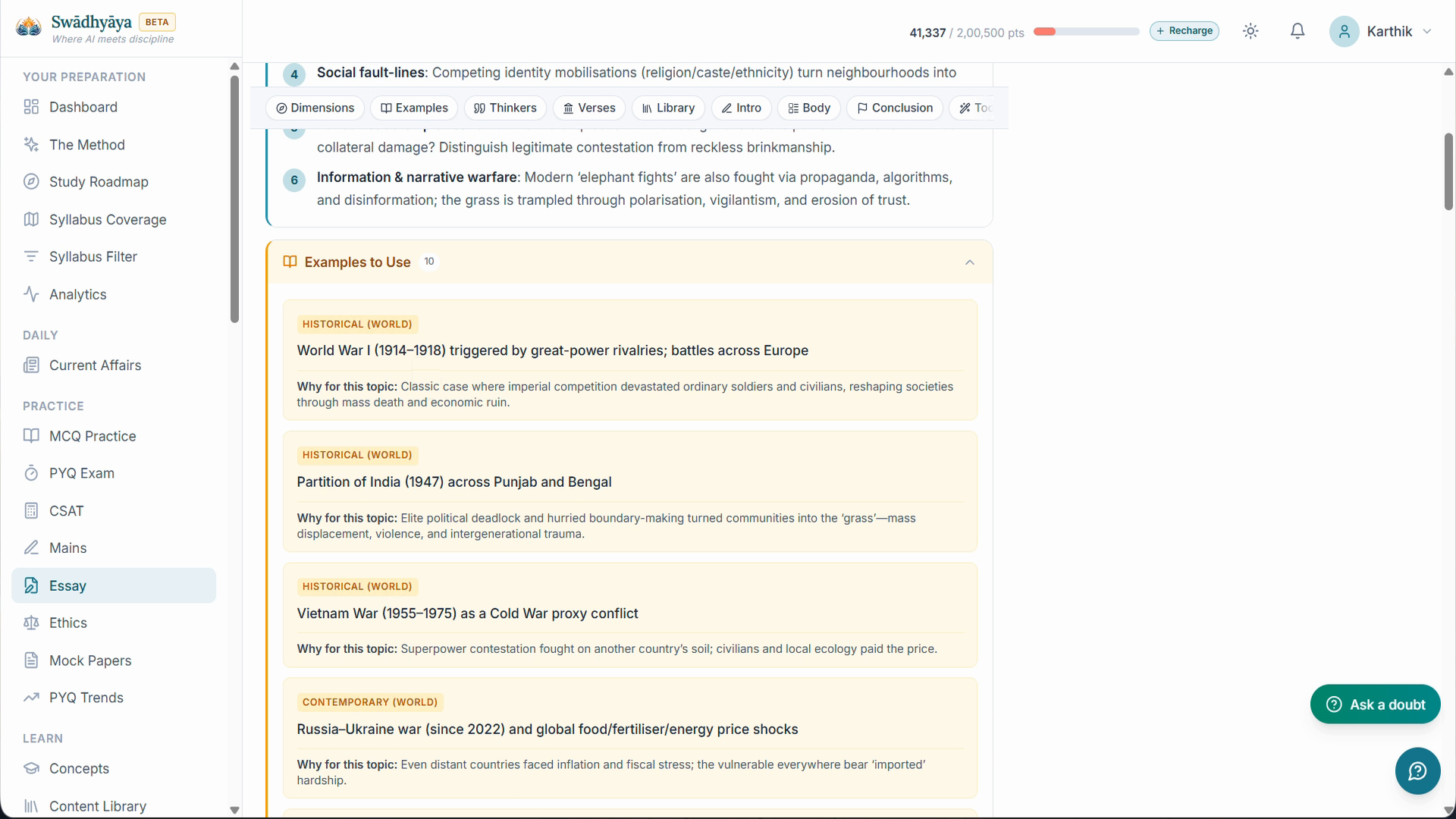
- Material that fits the topic — not a pool of 50 memorised quotes, but Sanskrit verses, book quotes, historical anecdotes, and contemporary examples you can pull from thematically.
- A philosophical anchor — the essay has to argue something. Not a survey; a position with defended nuance.
- Honest evaluation that tells you where the essay went flat, where the argument thinned, where a section wandered off-topic.
How Swādhyāya's Essay module runs this
Every essay topic opens with a brainstorm scaffold: multiple dimensions laid out (historical, philosophical, present-day, contrarian) so you can hold the topic before committing to a structure. You pick which dimensions you'll build around.
You have access to a Sanskrit Quotes bank, Book Quotes bank, and a Philosophical Lens that surfaces thinkers whose work speaks to the topic. Not to be quoted verbatim — to think alongside.
You write the essay. AI evaluation returns dimension-wise feedback: introduction, argument coherence, evidence usage, philosophical grounding, conclusion. Each with a specific fix.
What makes it different
- Multi-dimensional brainstorm. The scaffold opens the topic on four+ axes before you commit to structure.
- Original material banks. Sanskrit verses and book quotes indexed by theme, not memorised by rote.
- Philosophical Lens. Named thinkers whose frameworks speak to the topic — Rawls on justice, Sen on capabilities, Aurobindo on consciousness.
- Voice-preserving evaluation. Feedback that sharpens your essay, not a model essay that replaces it.
Where to start
Pick a PYQ Essay topic that intimidates you. Open the brainstorm scaffold. Sit with the dimensions for 10 minutes. Write. Submit for evaluation.
The first attempt will feel different from the ones you've been writing.