Most Current Affairs prep produces a folder of monthly PDFs nobody re-reads. The gap isn't information. It's the missing link between the news story and the specific Prelims MCQ or Mains prompt it becomes on exam day.
Why headline-aggregated CA fails
The typical CA subscription: 15-25 news items per day, summarised, tagged loosely with "GS1" or "GS3", downloaded as PDF. By month-end, you have 400 items in a folder that nobody has time to re-read. Exam day arrives and specific facts — the year, the ministry, the amount, the ranking — evaporate.
What Current Affairs actually needs isn't more coverage. It's fewer items, treated with the syllabus depth they deserve, surfaced when memory needs the reminder.
What Current Affairs preparation needs
- Syllabus mapping at sub-topic depth — not "GS3", but "Economic growth → Fiscal Deficit → FRBM framework" so the CA slots into what you already know.
- Digest depth, not headline breadth — the 3-4 items that matter for Prelims + Mains this week, not the 25 that filled today's newspaper.
- Practice conversion — every CA item should turn into 2-3 practice MCQs and a Mains-answerable question, not sit as prose to re-read.
- Spaced revision — items you struggled with resurface at spacing that fits how memory actually works, not once a month.
How Swādhyāya's Current Affairs module runs this
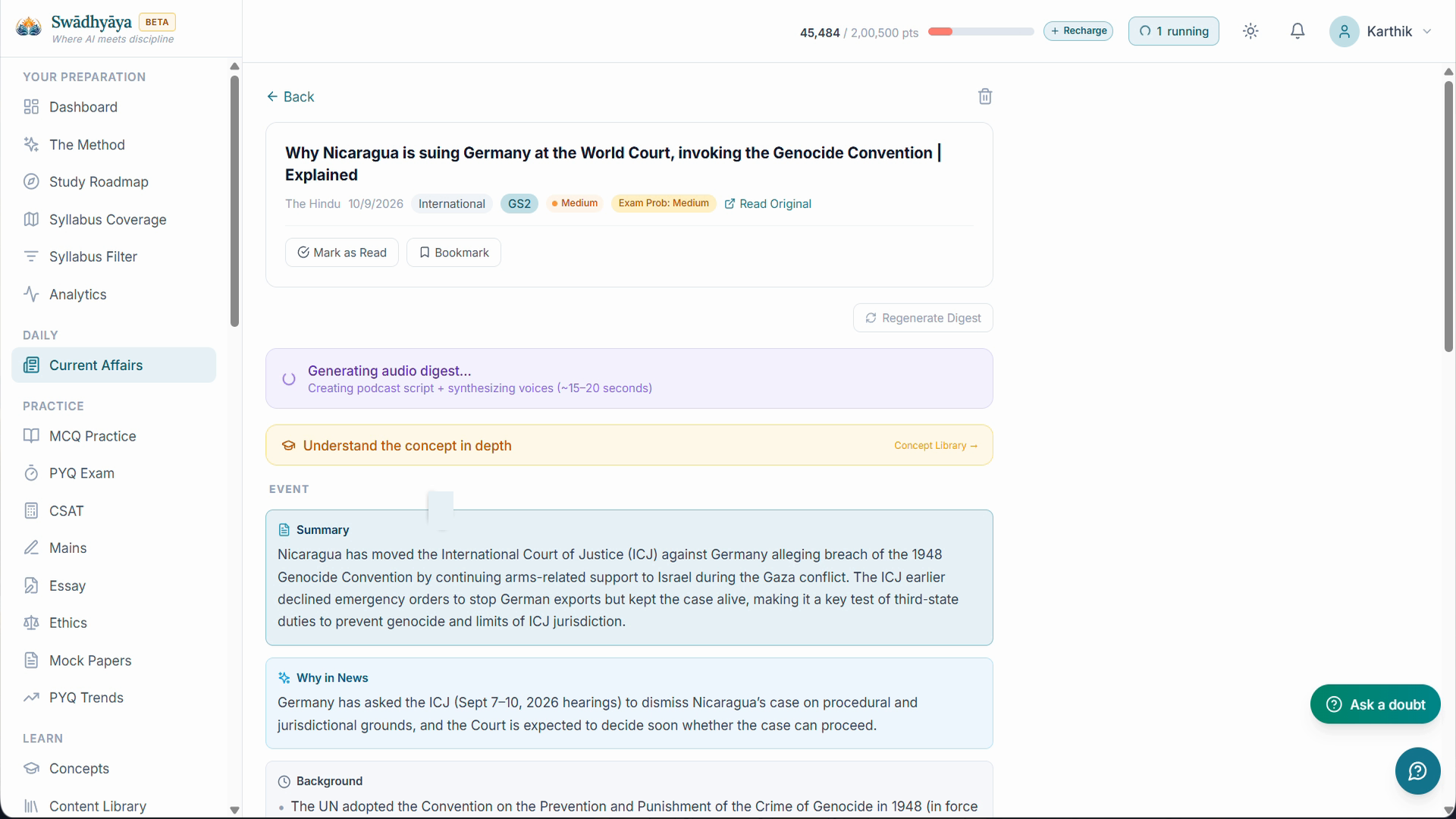
Daily digest synthesised from PIB, The Hindu, Indian Express — 3-6 items per day, each with GS syllabus mapping, background context, and Prelims/Mains angle laid out. Not a headline list. A study card.
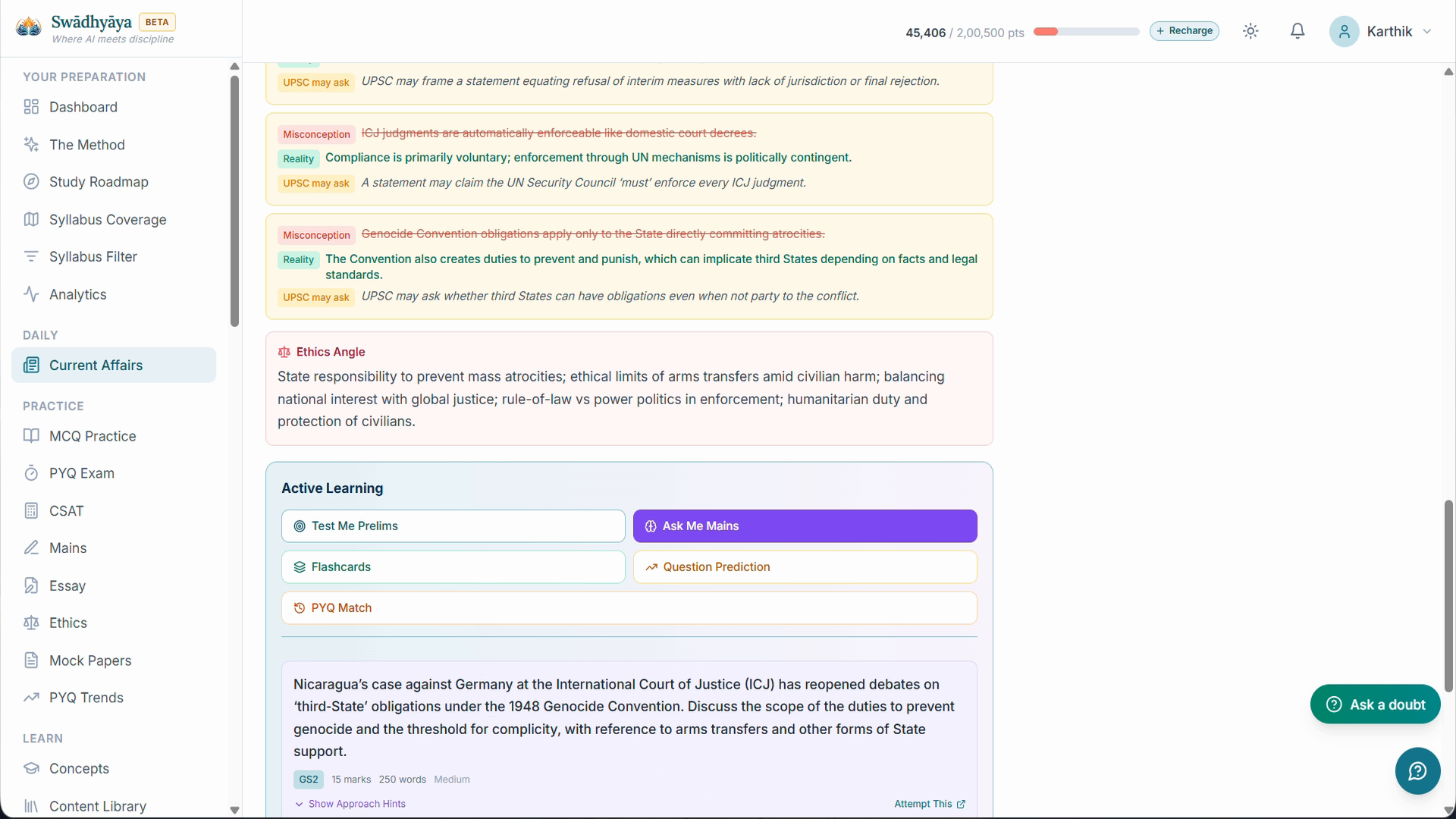
Every digest item becomes practice: 2-3 auto-generated Prelims MCQs and a Mains-answerable question that turn the CA into a testable signal. You practice as you learn — the item lodges.
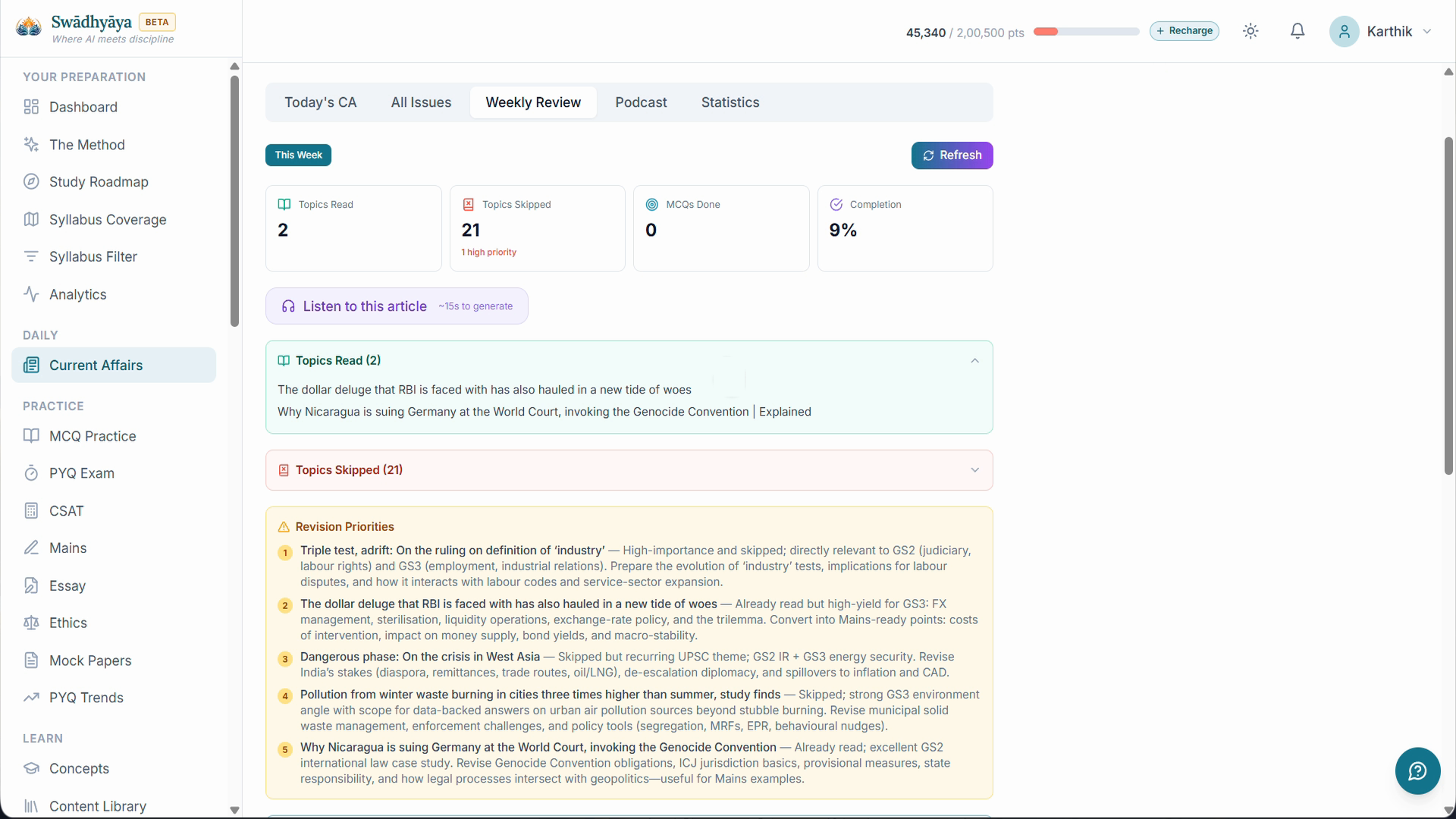
Wrong MCQs and un-attempted Mains prompts surface again on their own — spaced revision that fits how you actually forget. Not a monthly PDF you scroll through the night before Prelims.
The GS-linked context also feeds Mains directly: if the Mains prompt on paper day is about digital agriculture, and you covered PM-KISAN + Digital Agriculture Mission in CA a month ago, the connection is one click away — the CA digest, the practice you did on it, your notes on it, all attached to the same topic.
What makes it different
- Sub-topic syllabus mapping. Not "GS3", but the specific chapter and sub-topic — so it slots into what you already study.
- Auto-generated practice. Every digest item becomes MCQs and a Mains-answerable prompt.
- Spaced revision, not chronological archive. Items resurface when you'd forget, not by date.
- Connected to Mains + Content Library. A Fiscal Deficit CA today links to the FRBM Content Library card + the GS3 Mains PYQs on the same topic.
Where to start
Open today's digest. Read three items. Attempt the practice on each. Come back tomorrow — the ones you struggled on will resurface.
Two weeks and the difference from monthly PDF-scrolling is obvious.