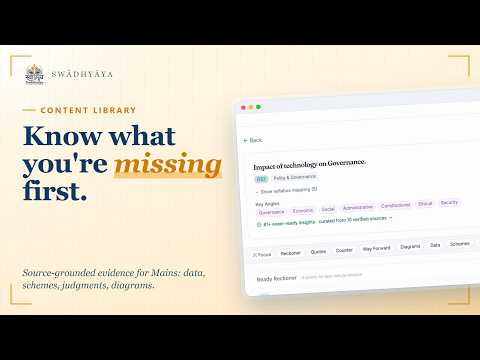
Every UPSC aspirant hits the same wall: hours reading, no organised material to recall from. Not because the content isn't out there. Because there's no structure that connects what you read to what a question demands.
Why static PDFs and books stop scaling
A coaching module gives you a 200-page PDF on Fiscal Federalism. You read it in Week 3. Week 12 arrives. A Mains prompt demands a specific committee recommendation, a specific scheme with year and coverage, a Supreme Court judgment on Article 275. You remember reading about it. You can't retrieve the specific fact. The PDF is somewhere in a folder.
The failure isn't that the content didn't exist. It's that "read the PDF once" isn't a retrieval system. What you need is content structured by the shape a Mains answer demands — schemes with year + ministry + coverage, judgments with case name + doctrine + year, data with source + year + trend — retrievable at the moment you write.
What retrievable content actually looks like
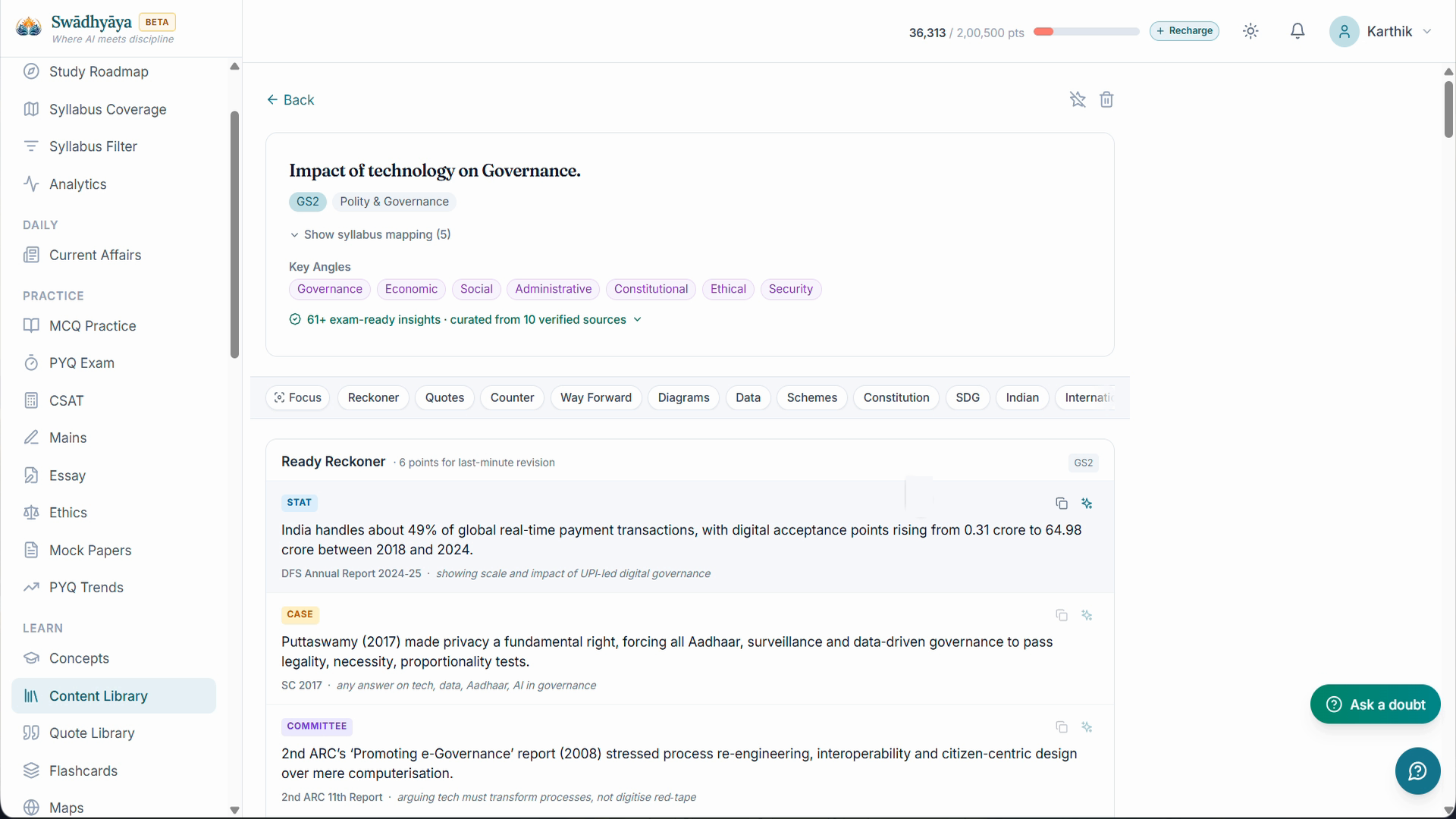
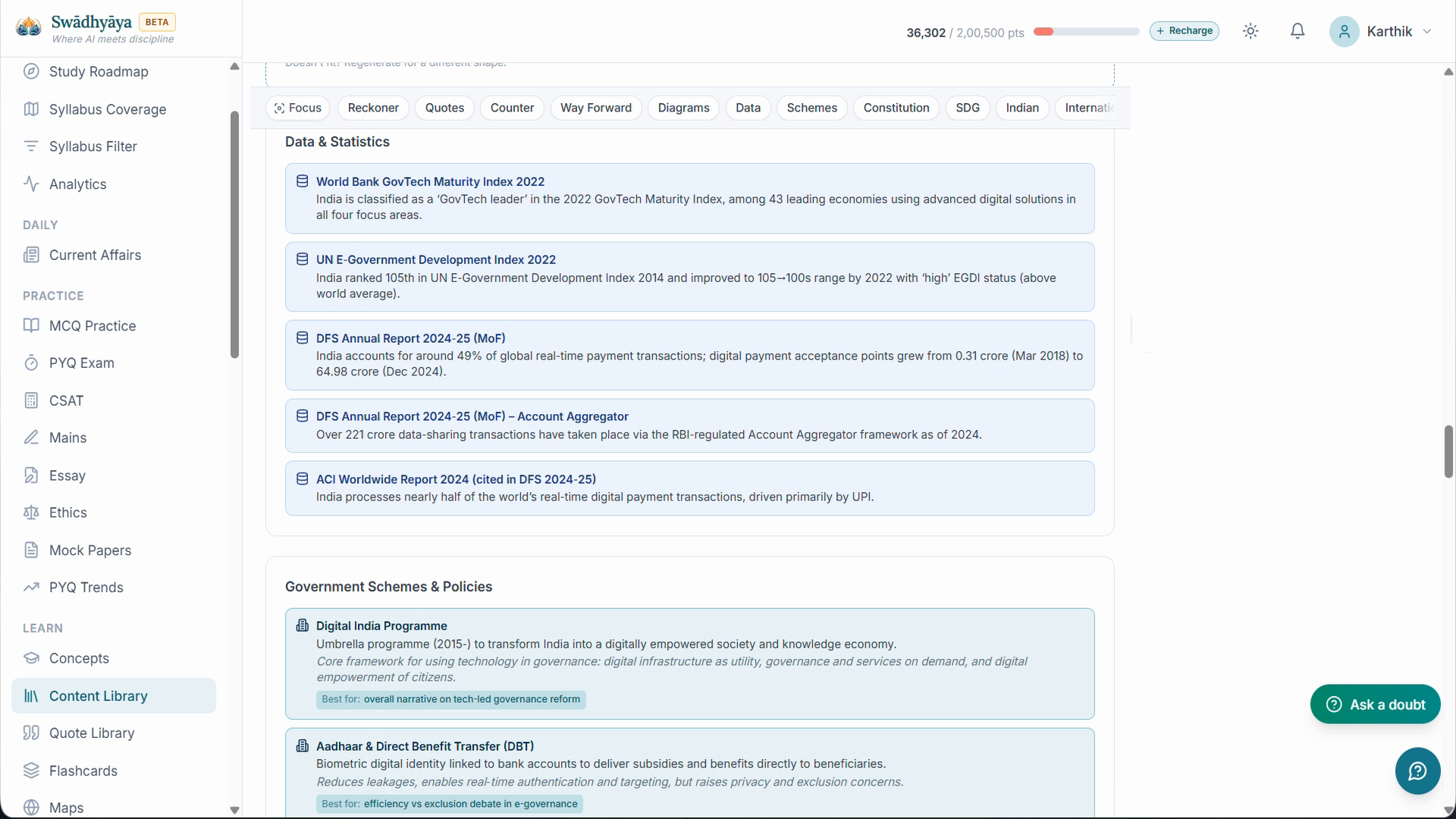
- Schemes with launch year, ministry, coverage, key features, beneficiaries.
- Judgments with case name, doctrine, year, subsequent extensions.
- Data points with source, year, quantifiable value, trend.
- Committee recommendations with chairperson, year, brief.
- Constitutional provisions with article number, section, provision.
- Examples — Indian, international, current affairs.
- Diagrams where the topic supports a visual (mermaid diagrams for policy cycles, budget flow, institutional structure).
Every topic worth studying has these seven dimensions. The Content Library generates them, per topic, on demand.
How Swādhyāya's Content Library works
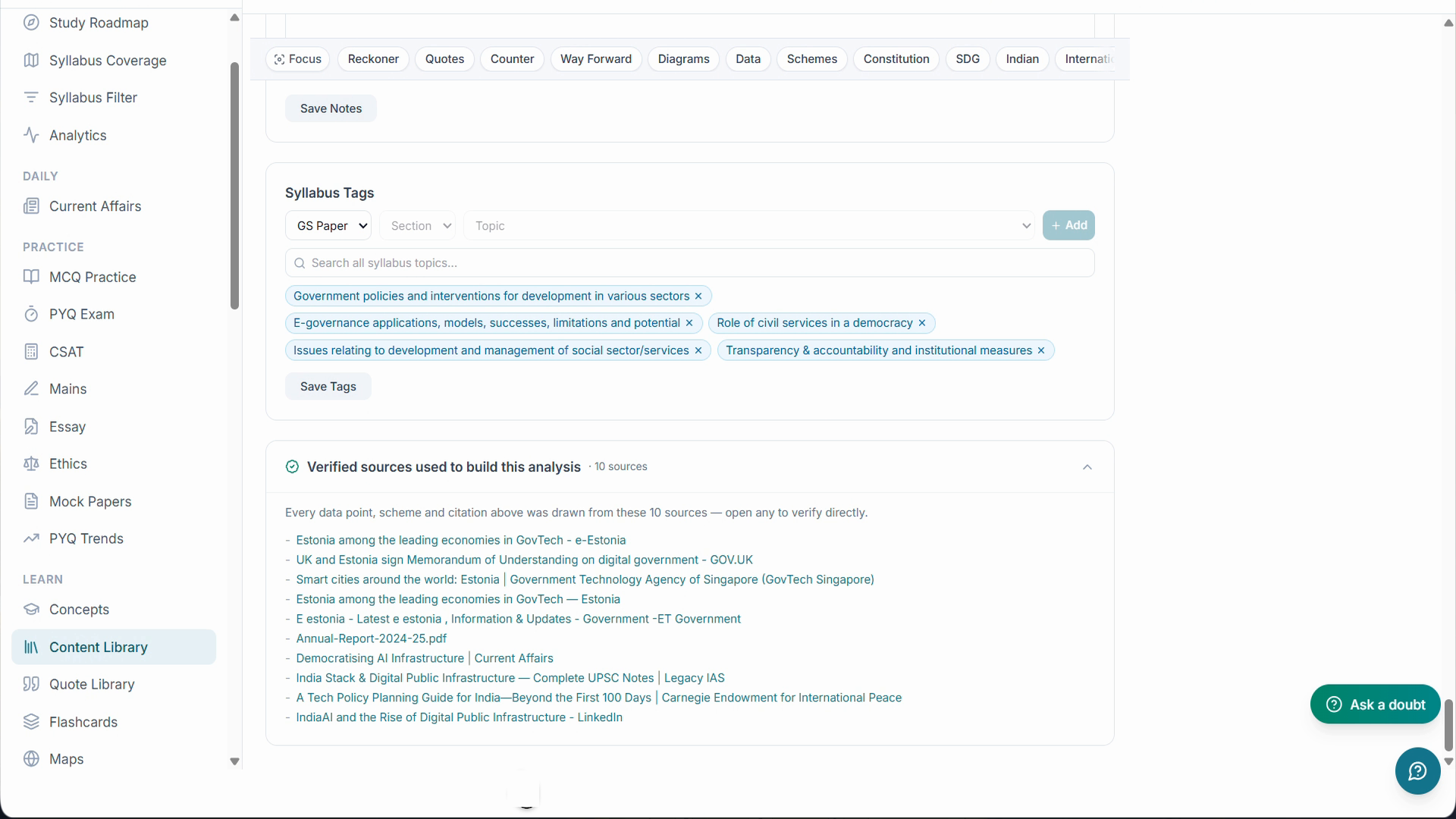
You enter a topic — "Cooperative Federalism", "PMLA", "Green Hydrogen Mission", "Article 356". Swādhyāya generates a structured card covering the seven dimensions: schemes, judgments, data, committees, provisions, examples, diagrams. Each item is sourced (PIB, official ministry, Supreme Court, Economic Survey) so you can trust it.
You save the topic to your library. Next time it comes up in a Mains prompt or a CA digest, the connection is one link away. The card is yours to revise from — not a 200-page book you have to re-scan.
Where a topic has visual structure (budget cycle, policy hierarchy, institutional composition), the card generates a mermaid diagram — hand-drawable in the exam under 90 seconds. Diagrams travel with the answer.
What makes it different from a book or coaching module
- On demand, per topic. Not a monolithic PDF. The specific topic you need, when you need it.
- Structured by answer shape. Every dimension is what a Mains answer asks for — schemes with year, judgments with doctrine, data with source.
- Retrievable. Saved to your library. Linked to CA digests, Mains PYQs, related Content Library cards.
- Includes diagrams. Hand-drawable in the exam. Nobody else generates topic-specific diagrams.
Where to start
Pick a topic you keep saying you'll "read more on" — one that has been sitting in your notes as a gap. Generate its Content Library card. Save it.
Now revise from that card instead of the PDF you never re-open.